
Insights from Toronto Climate Week: From Carbon Management to Climate Resilience
The climate crisis used to be a problem we debated. Now it is a bill we are starting to pay.
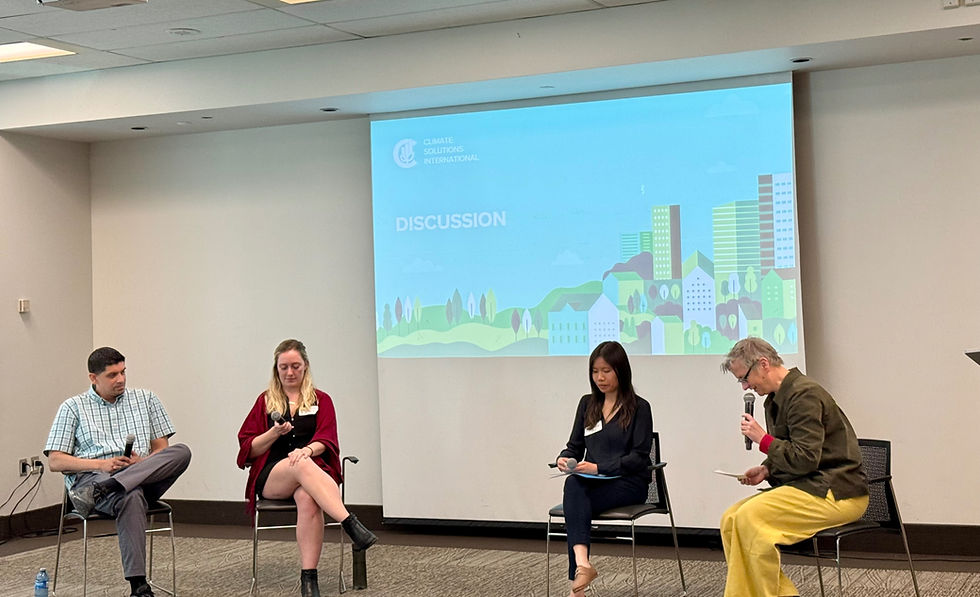
Last week at Toronto Climate Week (TOCW), I sat in sessions full of practitioners, policymakers, entrepreneurs, and investors. But what struck me most was not the urgency in the air, but the sobriety. The panic-and-pledge era is giving way to something more serious: the hard, unglamorous work of actually restructuring how businesses operate, how capital is allocated, and how cities are built before the next extreme weather event forces the decision for us. Three trends stood out.
1. From Mitigation to Adaptation: The Urgency Is Now Physical
When I began my career as a carbon management consultant over a decade ago, the first few client meetings were often consumed by a single task: explaining what climate change actually was: its science, its connection to carbon emissions, and its relevance to business strategy. The Kyoto Protocol was the policy anchor, and our work centred on emission reduction pathways and net-zero transition roadmaps.
That conversation has fundamentally changed.
Climate impacts are no longer theoretical. They are showing up in insurance premiums (sometimes disappearing from coverage entirely), in infrastructure damage assessments, and in operational disruptions. Businesses and municipalities are no longer asking whether climate change will affect them; they are asking how much and how soon. The City of Toronto and many municipalities around the world have moved from studying climate adaptation to actively implementing adaptation plans. Leading corporations are embedding scenario analysis, aligned with TCFD and, increasingly, IFRS S2, into their enterprise risk frameworks to stress-test supply chains against physical climate hazards.
Perhaps the most significant mindset shift I observed is the framing of the cost of climate inaction. For years, climate investment was evaluated against the direct cost of mitigation and implementing adaptation measures. Today, forward-thinking organizations are modelling what doing nothing actually costs: in stranded assets, disrupted supply chains, regulatory penalties, and reputational loss. Building resilience has moved from a PR exercise to a board-level fiduciary imperative.
2. Climate Strategy Is Moving to the Core, and Breaking Down Silos
For much of the past two decades, climate strategy was largely the domain of communications teams and facilities managers. While it was well-intentioned, it was organizationally siloed. The result was sustainability reports that looked polished but rarely changed how capital was allocated or how operational decisions were made.
What I’m seeing now is structurally different. Climate risk is increasingly finding its way into procurement, treasury, real estate, product development, and investor relations. It is not merely regarded as a compliance overlay, but as an input to core business decisions. This integration is difficult and slow, but the organizations that achieve it gain a genuine competitive edge: better risk-adjusted capital allocation, stronger regulatory positioning, and more credible disclosure.
I am reminded of a moment from my consulting days, just before I stepped away to care for my first child. A client, who was the chairperson of the sustainability committee at a global marketing and distribution company, said something that has stayed with me: “When this project kicked off, I honestly doubted we could ever bring climate strategy to our departments globally. Now, after all the ups and downs, I see the real value to our business. Thank you for walking in this challenging journey with us.” That transformation required patience, cross-functional trust, and a willingness to challenge entrenched ways of working. It remains one of the most rewarding engagements of my career, and a reminder that organizational change is often harder than the technical solution.
3. Climate Tech Has Outgrown Clean Tech
For much of the last decade, “clean tech” and “green tech” were the dominant frames for climate-oriented investment, such as renewable energy, energy storage, EV infrastructure, carbon capture. These remain critical, but the definition of climate technology has expanded materially, and investors who haven’t updated their lens risk missing a significant emerging opportunity set.

As the world enters an era of intensifying physical climate hazards, including more frequent and severe droughts, floods, wildfires, and heat events, a new category of adaptation-enabling technology has emerged. Precision irrigation and agritech platforms addressing water stress, advanced water and wastewater treatment technologies that optimize energy and resource recovery, and wildfire detection and early warning systems are now firmly within the climate tech universe. So are climate risk analytics, physical risk modelling platforms, and nature-based solution monitoring tools.
For investors, however, this evolution demands a recalibration of expectations. The compressed investment cycles that characterize AI and software, where returns can materialize in months, do not apply here. Climate technology operates at the intersection of the digital and physical worlds: it must be validated against real physical conditions, seasonal variability, regulatory frameworks, and infrastructure constraints. Honest evaluation horizons of three to five years are not a weakness of the asset class but a reflection of its depth and durability.
The investors who will lead in this space are those who combine financial discipline with genuine scientific and systems literacy, and most importantly, the patience to let the technology prove itself against the real world.
[Also published on Substack "Ginci Insights" on June 10, 2026]


Comments